How AI Is Transforming Outdoor Advertising: From Billboard Discovery to Smarter Campaigns
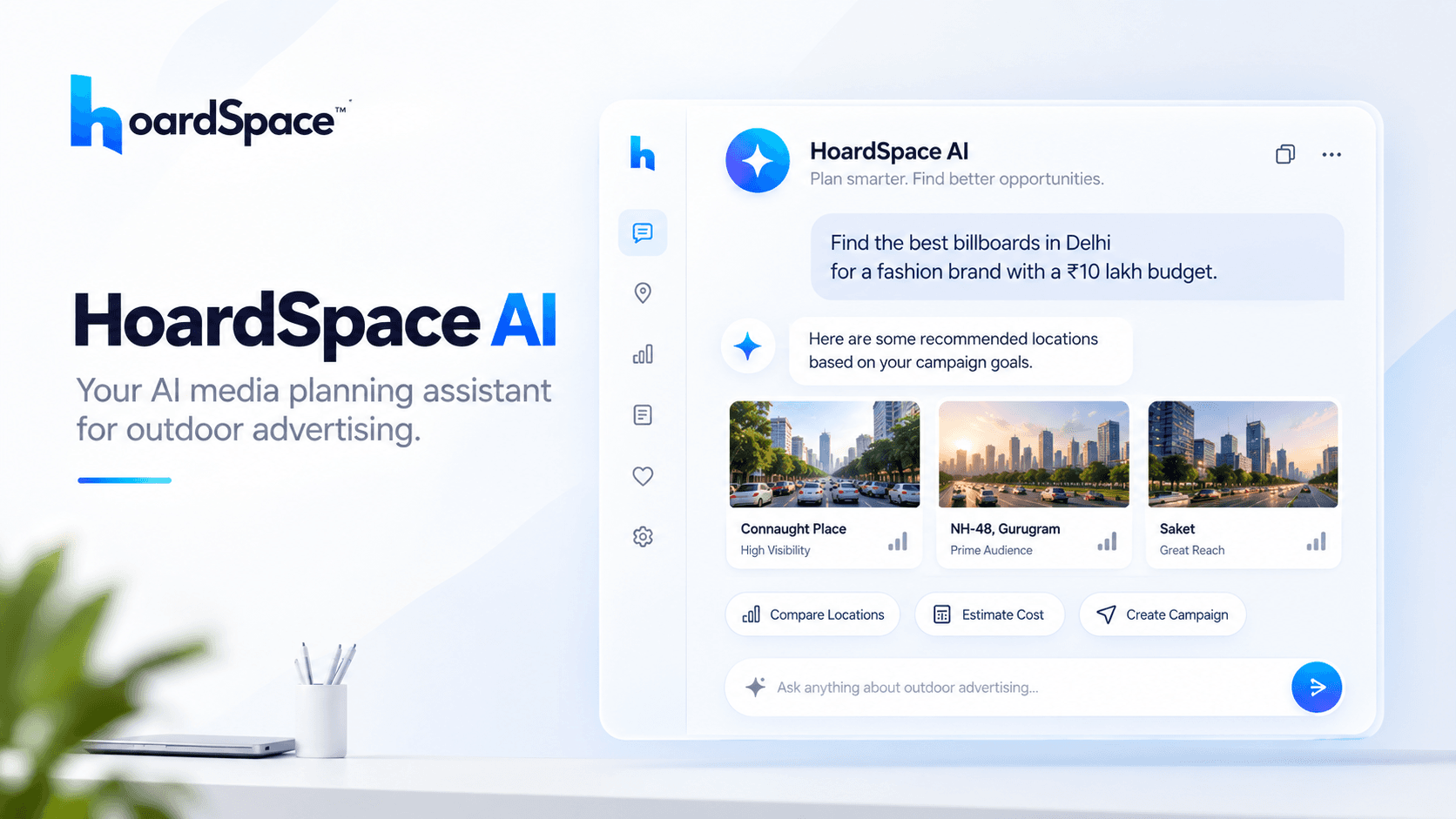
How AI Is Transforming Outdoor Advertising: From Billboard Discovery to Smarter Campaigns
Outdoor advertising has always been about one thing: being seen in the right place at the right time.
But finding that right place has traditionally involved a lot of manual research. Advertisers have to compare locations, understand audiences, estimate reach, evaluate costs, and coordinate with multiple media owners before launching a campaign.
Artificial intelligence is changing that.
AI is making outdoor advertising more data-driven, searchable, personalized, and efficient. Instead of treating billboards as static physical spaces, advertisers can now use data and AI to understand which locations are relevant to a particular brand, audience, budget, and campaign objective.
This is the direction HoardSpace is taking with HoardSpace AI.
What Is AI in Outdoor Advertising?
AI in outdoor advertising refers to using artificial intelligence and data analytics to improve different stages of an OOH (Out-of-Home) advertising campaign.
This can include:
- Finding relevant billboard locations
- Understanding audience demographics
- Estimating reach and impressions
- Comparing advertising locations
- Recommending media based on campaign objectives
- Calculating campaign costs
- Analyzing large inventories of outdoor media
- Automating campaign planning
- Helping advertisers make data-driven decisions
Traditional OOH planning often starts with a question like:
"Which billboards are available in Mumbai?"
AI-powered planning can move that question toward:
"Find high-visibility outdoor advertising locations in Mumbai that can help a consumer brand reach young professionals within a ₹10 lakh budget."
That difference is significant.
The first question is about inventory.
The second is about decision-making.
Why Does Outdoor Advertising Need AI?
The outdoor advertising ecosystem generates a large amount of information.
A single billboard can have dozens of attributes:
- Location
- Size
- Format
- Traffic patterns
- Estimated reach
- Audience demographics
- Nearby landmarks
- Visibility
- Pricing
- Availability
- Media owner
- Advertising category
- Historical performance
Now imagine thousands of billboards across hundreds of cities.
Manually comparing this information becomes difficult.
AI can process large amounts of structured and unstructured data and turn it into useful recommendations.
This creates an opportunity to move OOH from a largely inventory-driven process toward intelligent media planning.
1. AI-Powered Billboard Discovery
One of the simplest applications of AI is improving how advertisers search for outdoor media.
Instead of browsing through hundreds of listings manually, advertisers can describe what they need using natural language.
For example:
"I want billboards near major IT hubs in Bengaluru for a technology company."
An AI system can interpret the intent and identify relevant inventory based on factors such as:
- Location
- Audience
- Industry
- Budget
- Billboard characteristics
- Estimated reach
This makes billboard discovery more similar to having a media planning assistant than browsing an inventory database.
2. Audience and Demographic Intelligence
Location alone does not determine whether a billboard is useful.
The people who see it matter just as much.
AI can combine location and audience data to help advertisers understand characteristics such as:
- Age groups
- Gender distribution
- Income segments
- Occupation
- Consumer interests
- Residential vs commercial audiences
- Traffic patterns
For example, a luxury automobile brand may want to prioritize locations with audiences that align with its target customer profile.
A mass-market consumer brand may have very different requirements.
AI can help connect the advertiser's target audience with the audience surrounding a physical location.
3. Reach and Impression Estimation
One of the biggest questions in OOH advertising is:
"How many people are likely to see my advertisement?"
AI can assist in estimating potential reach and impressions by analyzing available location and audience data.
Depending on the data available, models can consider factors such as:
- Traffic volume
- Location
- Road characteristics
- Audience density
- Billboard visibility
- Time patterns
- Historical observations
- Nearby points of interest
These estimates should be treated as estimates rather than guaranteed audience numbers.
The goal is not to create a magical number.
The goal is to give advertisers a better quantitative basis for comparing locations.
4. AI-Based Billboard Recommendations
Imagine an advertiser has a budget of ₹5 lakh and wants to reach college students in a particular city.
Instead of manually looking through hundreds of billboards, AI can evaluate the available inventory against the campaign requirements.
The system could consider:
Campaign objective
→ Target audience
→ Location
→ Budget
→ Campaign duration
→ Desired reach
→ Billboard characteristics
And return a shortlist of potentially relevant locations.
This transforms the workflow from:
Search → Browse → Compare → Calculate → Decide
into:
Describe → Analyze → Recommend → Review → Decide
The final decision still belongs to the advertiser, but AI can dramatically reduce the amount of manual work required to reach that decision.
5. AI for Campaign Cost Calculation
OOH campaigns can involve multiple locations, vendors, formats, and campaign durations.
Calculating the total cost manually can become tedious.
AI-powered systems can help advertisers estimate:
- Media cost
- Campaign duration
- Number of locations
- Estimated reach
- Cost per impression
- Potential CPM
- Total campaign budget
For example:
20 billboards × 30 days × media cost per location
can be combined with audience estimates to provide a broader view of campaign economics.
This allows advertisers to compare not only which billboard is cheaper, but also how the cost relates to the potential audience.
6. AI-Powered Natural Language Campaign Planning
One of the most interesting applications of AI is allowing advertisers to communicate with the platform naturally.
Instead of navigating multiple filters, an advertiser could say:
"I have a ₹15 lakh budget. I want to advertise a new fashion brand in Delhi for 30 days and target young working professionals."
The AI can interpret the campaign requirements and use available inventory and data to help construct a potential media plan.
This is where AI moves beyond being a search feature.
It becomes a planning interface.
7. AI-Generated Billboard Insights
AI can also turn raw billboard data into understandable insights.
For example, instead of showing an advertiser dozens of fields, an AI system can summarize a location:
Location: Major commercial corridor
Estimated audience: High
Audience profile: Predominantly working professionals
Nearby landmarks: Offices, shopping destinations and transit points
Visibility: High
Suitable categories: Consumer brands, financial services, technology, retail
This makes complex inventory data easier to understand, especially for advertisers who may not be OOH specialists.
8. AI Can Help Media Owners Too
AI is not only useful for advertisers.
Media owners and outdoor advertising vendors can also benefit.
AI can help with:
- Generating billboard descriptions
- Categorizing inventory
- Extracting information from documents
- Improving listing quality
- Identifying missing information
- Generating audience insights
- Organizing large inventories
- Automating repetitive administrative work
For vendors managing hundreds or thousands of advertising assets, automation can save substantial manual effort.
HoardSpace AI: Bringing AI Into Outdoor Advertising
This is where HoardSpace AI comes in.
HoardSpace is building a technology-driven marketplace for outdoor advertising, connecting advertisers with outdoor advertising inventory across locations.
HoardSpace AI is designed to make the process more intelligent by allowing users to interact with outdoor advertising inventory using AI.
Instead of simply asking:
"Show me billboards."
Advertisers can interact with their campaign requirements and ask questions about available inventory.
For example:
"Find suitable billboards for a ₹10 lakh campaign in Bhubaneswar."
Or:
"Compare these three locations based on audience and estimated reach."
Or:
"Which of these locations would be suitable for a consumer-facing brand?"
The AI can then work with the underlying HoardSpace inventory and data to provide relevant information.
What Can HoardSpace AI Help With?
HoardSpace AI can bring several capabilities together in one interface.
1. Inventory Search
Advertisers can search and explore available outdoor advertising inventory using natural language.
2. Billboard Comparison
AI can help compare locations using factors such as:
- Price
- Location
- Estimated reach
- Audience
- Demographics
- Format
- Size
- Campaign duration
3. Campaign Cost Calculation
Advertisers can explore potential campaign combinations and understand the associated costs.
4. Audience Intelligence
AI can help interpret demographic and location-level information to identify potentially relevant advertising opportunities.
5. Reach Estimation
AI can surface available reach and audience estimates to help advertisers compare different media options.
6. Campaign Planning
Advertisers can describe their campaign requirements and use AI to explore potential media plans.
7. Wishlist and Booking
Once advertisers identify relevant locations, the workflow can move from discovery toward shortlisting and booking.
From Billboard Marketplace to AI Media Planning
This distinction is important.
A traditional marketplace primarily answers:
"What inventory is available?"
An AI-powered media platform can help answer:
"What inventory might make sense for my campaign?"
That shift can make outdoor advertising significantly easier to navigate.
The objective isn't to replace media planners or advertisers.
It is to give them better tools.
AI + OOH: The Future of Outdoor Advertising
The future of OOH advertising is likely to involve much more than simply digitizing billboard listings.
The larger opportunity is connecting:
Inventory + Location + Audience + Pricing + Data + AI
When these components work together, advertisers can move toward more informed media planning.
AI can help reduce the time spent searching, comparing, calculating, and organizing information.
At the same time, better structured data can make outdoor advertising more measurable and easier to evaluate.
The Human Decision Still Matters
AI can process information quickly, but outdoor advertising is still a real-world medium.
A model cannot completely understand every factor that can influence a billboard's effectiveness.
For example:
- Actual visibility can vary.
- Traffic conditions change.
- Creative quality matters.
- Brand context matters.
- Audience behavior is not perfectly predictable.
- Estimated reach is not the same as guaranteed attention.
Therefore, AI should be treated as a decision-support system, not an oracle.
The best workflow is:
AI analyzes → AI recommends → Human evaluates → Campaign executes
The Bigger Opportunity for OOH Advertising
Outdoor advertising has enormous physical reach, but historically, planning it has involved fragmented information and significant manual effort.
AI creates an opportunity to make that process more accessible.
An advertiser should eventually be able to describe a campaign in plain language, understand the available options, compare locations, evaluate estimated reach and costs, and move toward execution without navigating dozens of disconnected tools.
That is the direction in which platforms like HoardSpace AI are pushing OOH advertising.
The billboard isn't becoming intelligent.
The way we choose the billboard is.
Conclusion
Artificial intelligence is transforming outdoor advertising from a largely inventory-focused process into a more data-driven planning experience.
From billboard discovery and demographic analysis to reach estimation, campaign planning, cost calculation, and recommendations, AI can reduce manual effort while helping advertisers work with large amounts of OOH data.
HoardSpace AI brings these capabilities closer to the actual outdoor advertising workflow, connecting AI with real-world billboard inventory.
As OOH advertising becomes increasingly digital and data-driven, the competitive advantage may no longer come simply from having more inventory.
It may come from helping advertisers understand that inventory better and make faster, more informed decisions.
HoardSpace AI is building toward that future — where finding the right outdoor advertising space starts with a conversation, not a spreadsheet.