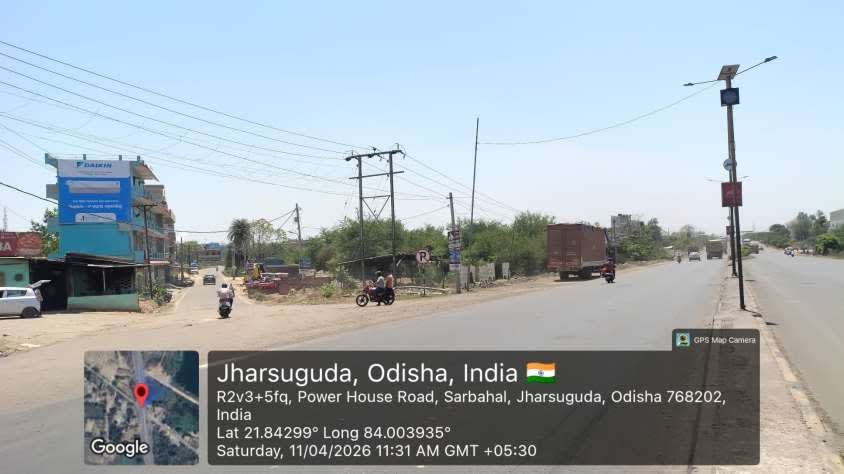
Wallwrap Hoarding - Jharsuguda - Jharsugda Power House Sarbahal
R2v3+5fq, Power House Road, Sarbahal, Jharsuguda, Odisha 768202,, Jharsuguda, Odisha
Property Details
Property TypeHoarding
Lit TypeNon-Lit
Size (W x H)20 x 25 Feet
Square Feet500 sq ft
Traffic Data28k+ unique reach/ week
AvailableImmediately
Rate per Sq Ft₹15 / sq ft
Description
 AI Insights by HoardSpace
Overview
This wallwrap hoarding is located on Power House Road in Sarbahal, Jharsuguda district, Odisha. Jharsuguda is an important industrial and power hub in western Odisha, known for its thermal power stations, aluminum industries, and railway connectivity. The hoarding is situated in a locality connected to the power generation infrastructure, which typically experiences steady vehicular and workforce movement. With dimensions of 20 ft × 25 ft and priced at ₹7,500/month, this hoarding offers an affordable advertising opportunity in a developing industrial town.
Location Highlights
Sarbahal is a residential and semi-industrial area near Jharsuguda's power generation facilities. Power House Road serves as a connector route for daily commuters, industrial workers, and local residents. The locality experiences regular movement due to its proximity to the power plant and related industrial establishments. Jharsuguda town is well-connected by rail and road, with the Jharsuguda Junction railway station being a major stop on the Howrah-Mumbai mainline. The area surrounding this hoarding primarily comprises worker colonies, local markets, and service establishments catering to the industrial workforce.
Traffic & Footfall Insights
Estimated Daily Vehicle Traffic: Approximate estimates suggest 6,000–14,000 vehicles/day, consisting primarily of two-wheelers, autorickshaws, commercial vehicles, and worker transport buses.
Estimated Daily Footfall: The surrounding locality may experience 1,500–4,500 pedestrians/day, including industrial workers, local residents, and shoppers from nearby residential areas.
Peak Activity Periods: The busiest hours are likely during shift changes at the power plant and industrial units—typically 7:00 AM–9:00 AM and 5:00 PM–7:00 PM—when workforce movement is at its highest.
Primary Audience: Industrial workers, technicians, supervisors, local residents, daily commuters, and families residing in worker colonies. The demographic includes middle-income households with stable employment.
Advertising Potential: This location is suitable for brands targeting working-class consumers with steady income, including FMCG products, financial services, mobile networks, local services, vocational training institutes, and consumer durables. Reliable public measurements are unavailable; these are locality estimates.
Hoarding Specifications
- Dimensions: 20 ft (Width) × 25 ft (Height)
- Total Display Area: 500 sq ft
- Monthly Price: ₹7,500
- Property Type: Hoarding
- Lighting: Non-Lit
- Visibility: Clear sightlines from Power House Road; visible to vehicular traffic and pedestrians during daylight hours
- Suitable Advertisement Size: Medium to large visuals with bold text work best; ensure high contrast for non-lit conditions
Best Suited For
- FMCG brands (beverages, snacks, personal care)
- Mobile networks and telecom offers
- Banking and microfinance services
- Local retail and consumer electronics
- Vocational training and skill development institutes
- Healthcare and insurance products
- Real estate and housing schemes
Why Choose This Hoarding?
- Strategically located on a road serving industrial workers and local commuters
- Affordable monthly rental makes it ideal for sustained local campaigns
- Captures attention of a stable, employed demographic with regular income
- Effective for building brand recall among the working-class population
- Suitable for regional and national brands targeting tier-3 industrial towns
Campaign Suggestions
- Launch consumer finance schemes or micro-loan products targeting industrial workers
- Promote affordable mobile plans, recharge offers, and data packs
- Advertise local retail stores, electronics showrooms, and FMCG products
- Highlight skill development programs and certification courses for employment growth
- Run awareness campaigns for health insurance, life insurance, and savings schemes
Important Note
The traffic, footfall, and reach figures provided are approximate estimates for the surrounding locality based on typical patterns in semi-industrial areas of Jharsuguda district. These are not measured statistics specific to this hoarding. Actual exposure may vary based on seasonal factors, road conditions, and local developments.
Select Campaign Dates
Start Date
Months
End Date (Calculated)
Pricing Details
Monthly Rent Price₹7,500
₹6,000
Mounting Charges (₹5/sqft)₹2,500
Printing and mounting are one-time charges. For subsequent months, only the rent will be applicable.
Total CostDuration: 1.0 Months
₹16,000+ GST
Location Map
Open in Google MapsEstimated Audience Demographics
AI Insights by HoardSpaceEstimated composition of the audience near this site, inferred from its location and the surrounding area.
Gender
- Male58%
- Female42%
Age groups
- 13–1712%
- 18–2418%
- 25–3428%
- 35–4422%
- 45–5414%
- 55+6%
Most spoken languages
Shares overlap — people speak more than one language.
- Odia~85%
- Hindi~45%
- English~20%
AI-generated estimates based on available location and audience signals. Not verified audience measurements. Estimated 29 Aug 2026.
Recommended Hoardings
Other listings near this location.