Outdoor advertising market research by HoardSpace
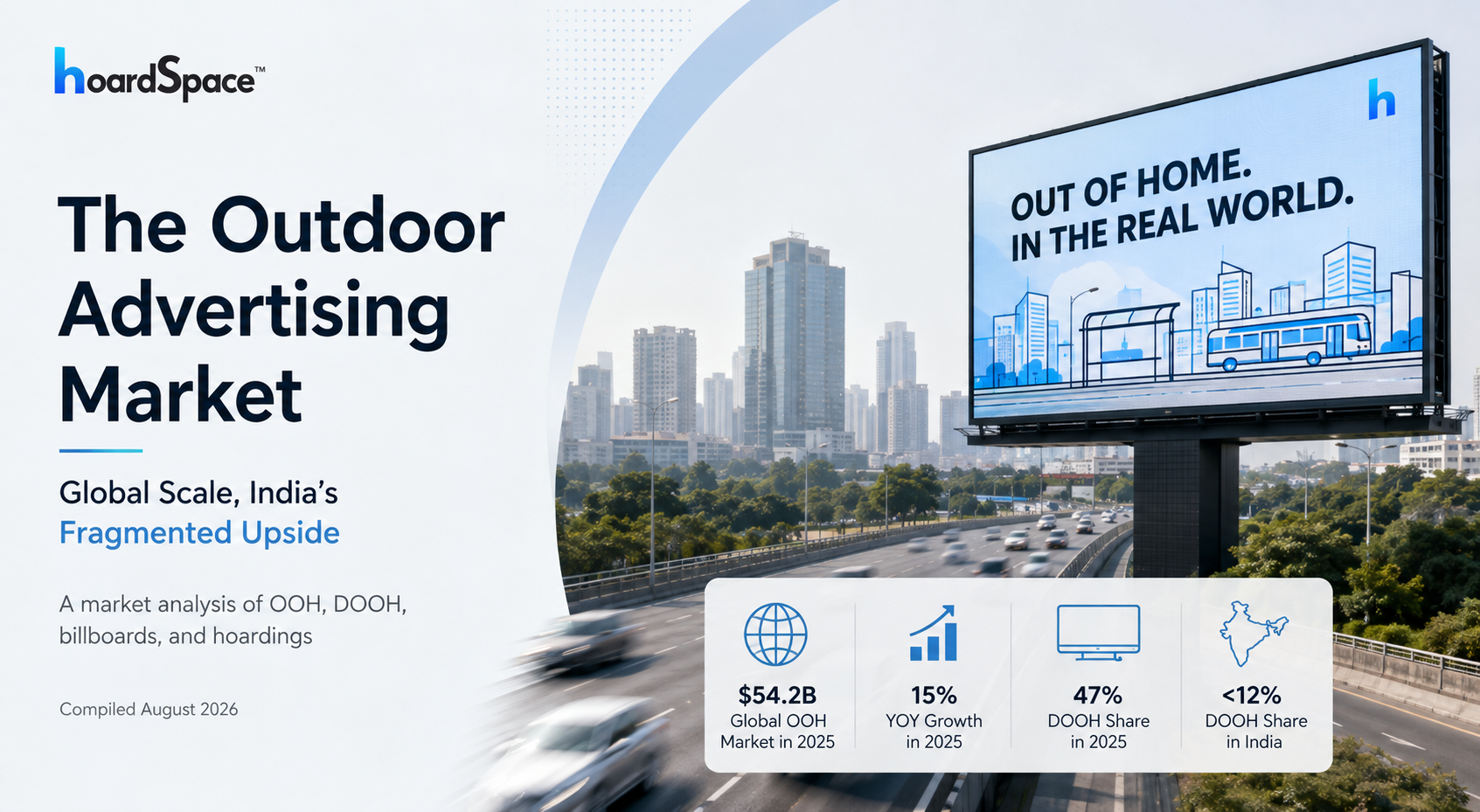
The Outdoor Advertising Market: Global Scale, India's Fragmented Upside
A market analysis of OOH, DOOH, billboards, and hoardings — prepared for Hoardspace Compiled August 2026
Global out-of-home advertising crossed $54.2 billion in 2025, grew 15% year-on-year, and is on track for $56.4 billion in 2026 — making it one of the few "traditional" media categories still gaining share against digital (World Out of Home Organization 2026 report, via invidis). The growth is almost entirely a digital story: digital out-of-home (DOOH) now accounts for 47% of that spend and is forecast to cross 49% in 2026, putting it on the verge of overtaking static formats for the first time. India tells a smaller, more lopsided version of the same story — OOH is the only traditional medium still growing there, but DOOH is stuck under 5–12% of it (against 40% in the US and 90% in China), and the market underneath it all remains genuinely fragmented, run by thousands of independent hoarding owners rather than a handful of national players. That gap between a large, consolidating global category and a small, fragmented Indian one is effectively the market opportunity a booking marketplace like Hoardspace is built to close. This report lays out the numbers behind both sides, flags where sources disagree, and ends with what the data implies for Hoardspace specifically.
Global OOH crossed $54 billion in 2025, and Asia-Pacific is more than half of it
The most reliable read on global OOH spend comes from the World Out of Home Organization (WOO), the industry's own global trade body, whose annual expenditure report is compiled from over 100 media owners, agencies, and OOH associations across 85 markets — a genuinely primary, bottom-up survey rather than a modeled estimate (WOO 2026 report, via BestMediaInfo). WOO puts 2025 global OOH spend at $54.2 billion, or 5.1% of all global advertising expenditure, growing to $56.4 billion in 2026. Dentsu's independent global ad forecast corroborates the direction, if not the exact figure, projecting OOH growth of 4.1% in 2026 — modest next to retail media (+14.1%) or online video (+11.5%), but still positive at a time when print is forecast to shrink 3% (Dentsu Global Ad Spend Forecast, December 2025).
Geographically, the market is heavily concentrated:
| Region | 2025 OOH spend | Share of global |
|---|---|---|
| Asia-Pacific | $29.7 billion | ~55% |
| North America | $10.3 billion | ~19% |
| Europe | $10.2 billion | ~19% |
| Latin America | $2.9 billion | ~5% |
| Africa | $1.2 billion | ~2% |
Source: WOO 2026 Global Out of Home Expenditure Report, via Marketing Report
At the country level, China is the single largest OOH market in the world at $18.2 billion, followed by the United States ($9.5 billion), Japan ($3.2 billion), the UK ($1.85 billion), and Germany ($1.71 billion). Worth flagging: PQ Media, a respected media-economics research firm, puts the US figure much higher — $14.64 billion for 2025, versus WOO's $9.5 billion — and China lower, at $16.65 billion (PQ Media, via PRWeb). Even the two most credible trackers in this category — an industry association survey and a specialist research firm — differ by 50%+ on the US number, most likely because they draw the line differently on what counts as OOH (place-based media, transit concessions, and government/municipal advertising are the usual grey areas). Treat any single-source OOH figure as an estimate with a real error bar, not a precise fact.
Digital is eating outdoor advertising's growth — and about to become the majority of it
DOOH generated $25.5 billion globally in 2025, 47% of total OOH revenue, and WOO forecasts it will hit $28 billion (49% of OOH) in 2026 — on track to overtake static/print OOH for the first time in the medium's history (WOO 2026 report). PQ Media's independent tracking shows the same deceleration-then-reacceleration pattern: DOOH grew 12% in 2025 (down from 15.5% in 2024), with growth expected to jump to 15.3% in 2026, driven by the Winter Olympics, the FIFA World Cup, and elections in 13 of the top 20 ad markets. Within DOOH, PQ Media splits digital place-based media ($18.2 billion, +12.4%) from digital billboards and posters specifically ($9.3 billion, +11.3%) — useful if Hoardspace ever needs to size the billboard-only digital opportunity rather than DOOH broadly.
Digital penetration of OOH varies enormously by region: 55.7% in Asia-Pacific, 41.3% in Europe, 36.9% in North America, 27.7% in Latin America, and just 18% in Africa. Australia is the single most digitized market, with DOOH at 60.6% of its total OOH spend. Programmatic DOOH — screens bought and sold in real time through ad exchanges, the same way display or video ads trade online — is still a small slice of that: $2.1 billion globally in 2025, 8.4% of DOOH revenue, though WOO has now launched an independently audited measurement study with PwC specifically because buyers don't trust the category's self-reported numbers yet. That trust gap is itself informative: the infrastructure for automated OOH trading exists (see the adtech section below), but the market hasn't converged on shared measurement standards the way open-web programmatic did a decade ago.
Billboards remain OOH's financial backbone, and a $6 billion buyout just bet on it
Within the format mix, large-format billboards and hoardings are still the biggest single category. India's own industry body puts hoardings and other large-format inventory at roughly 40% of OOH revenue, with transit media (airports, metro, buses) at 35–40% and street furniture making up the rest (Indian Outdoor Advertising Association resource center, figures compiled from EY/KPMG/Pitch Madison data — worth noting this specific breakdown is a few years old and due for a refresh). In the US, ownership of that billboard inventory is concentrated among a handful of public and quasi-public companies: Lamar Advertising controls roughly 25% of US OOH revenue, OUTFRONT Media 21%, and Clear Channel Outdoor 17%, with independents — smaller, often family-owned operators — collectively holding the largest single share at 36% (Sixteen:Nine market-share analysis). JCDecaux, the dominant player across Europe and Asia, is a minor presence in the US by comparison, at roughly 2.3% share — a reminder that even the "big four" global OOH names are really strong regional incumbents rather than one global market leader.
The clearest signal that institutional capital still believes in this category came in February 2026: Clear Channel Outdoor agreed to be taken private by Mubadala Capital — the Abu Dhabi sovereign-linked investor managing over $430 billion in assets — in partnership with TWG Global, in an all-cash deal valuing the company at $6.2 billion enterprise value, with shareholders paid $2.43 a share, a premium the company describes as 71% over its unaffected share price (Clear Channel Outdoor SEC 8-K filing, February 9, 2026; Bloomberg). Roughly $3 billion of that is committed equity capital earmarked explicitly for deleveraging and, per the incoming executive chairman's own statement, "investing in data, measurement and transaction platforms" — language that reads as a direct bet on the same digitization and platformization trend Hoardspace is riding in India. Lamar Advertising made a smaller but directionally similar move in August 2026, acquiring regional operator AdSource Outdoor Advertising. Clear Channel's own quarterly filings back up the growth story at the operating level too: consolidated revenue was up 8.7% year-on-year in Q2 2026 (helped by World Cup-related demand), and digital now makes up 44.6% of Clear Channel's total revenue, up from 40.0% just two years earlier — the same static-to-digital shift playing out inside one of the industry's largest balance sheets.
India's OOH industry: small, concentrated in one quarter, but the only traditional medium still growing
The Pitch Madison Advertising Report (PMAR), now in its 24th edition and published by Madison World in partnership with Pitch and exchange4media, is the closest thing India's ad industry has to an agreed benchmark — it's the report the Indian Outdoor Advertising Association itself cites, and the one every major agency and trade publication references each February. PMAR 2026 puts India's total advertising market (AdEx) at ₹1,55,105 crore in 2025 under its newly expanded definition (which for the first time folds in quick-commerce and MSME digital spending), up 12% over 2024, with digital now 60% of that total and traditional media 40% (PMAR 2026 coverage, Social Samosa). AdEx is projected to reach ₹1,74,605 crore in 2026.
Against that backdrop, OOH is small but structurally important: ₹4,650 crore in 2024 growing to ₹4,835 crore in 2025, a 4% increase — modest in percentage terms, but PMAR explicitly flags OOH as "the only Traditional medium witnessing aggregate growth" while linear TV (down 5% to ₹32,855 crore) and print lose ground (Exchange4media, February 2026). The growth pattern is lumpy rather than steady: the first half of 2025 was essentially flat, and Q3 alone — up 18% year-on-year — accounted for effectively 100% of the medium's full-year growth, with Q4 anchoring the revenue base. PMAR's 2026 framing describes OOH (including its digital form) as the "traditional survivor" and recommends media planners treat it as part of an integrated large-screen-plus-outdoor "attention system" rather than a standalone reach buy.
Other industry voices size the Indian OOH market considerably larger than PMAR does. Adonmo, a DOOH ad-tech player, is quoted describing the market as "valued upwards of ₹6,500 crore, growing at 10–15% year-on-year, with projections to reach ₹7,900 crore by 2027", and a separate industry estimate puts 2026 OOH at over ₹8,000 crore, growing 30%+ annually (Adgully; Adgully). Neither of those is a bottom-up industry survey the way PMAR is — both trace back to individual company or executive estimates quoted in trade press — so treat PMAR's ₹4,835 crore as the figure to anchor on and the higher numbers as the optimistic end of a real range, not a more accurate alternative.
India's DOOH gap is roughly the size of the whole opportunity
This is the statistic that matters most for a marketplace business: digital penetration of India's OOH market is still in the single digits to low double digits, against 40% in the US and roughly 90% in China. WPP Media's mid-year 2026 TYNY (This Year Next Year) report puts India OOH growth at 8.6% for 2026 to roughly $0.5 billion, while noting DOOH is "still less than five percent of total OOH spend" despite the country's mobile-first, data-driven advertising culture (WPP Media TYNY, via Storyboard18). Adonmo's industry estimate puts the figure higher, at 12% of India's roughly ₹6,500 crore OOH market, with digital screen count reaching approximately 150,000 units in 2024, three-quarters of them concentrated in the top 12 metro cities — meaning digitization outside India's biggest cities is barely underway. Either figure tells the same story: India has not yet had the digital transition that reshaped OOH in the US, China, and Australia, and closing even a third of that gap would multiply the addressable DOOH market several times over.
Programmatic buying — the mechanism that made DOOH scalable elsewhere — is following the same pattern. Roughly 40% of India's overall digital ad spend already clears programmatically, and industry forecasts put programmatic DOOH at around 20% of India's DOOH spend by 2026, up sharply from a low base two years earlier (Adgully). The barriers cited consistently across industry commentary are not demand-side — advertisers clearly want it — but structural: the absence of a standardized, trusted audience-measurement "common currency" for OOH screens, similar to what television and digital already have, plus a media-owner base too fragmented to plug into programmatic pipes easily. That measurement and fragmentation gap is precisely the layer a booking and discovery platform sits on top of and can help close, screen by screen.
One methodology warning worth carrying over from market-sizing work generally: the commercial "syndicated report" firms that size India's digital OOH market specifically disagree with each other by an order of magnitude. IMARC Group values India's digital OOH market at $2.43 billion in 2025, growing to $6.41 billion by 2034. A different firm, MarkNtel Advisors, puts the same market at just $284 million in 2024, growing to $620 million by 2030. A third, Mordor Intelligence, sizes India's entire OOH-and-DOOH market (static plus digital combined) at only $519.93 million in 2025, with the digital-only slice reaching just $254 million by 2031. That's roughly a 25x spread between the lowest and highest published "India digital OOH market" figures, all dated within the same year. This is consistent with a broader pattern in that tier of the market-research industry — investigative reporting from outlets like IPVM has documented these publishers producing high volumes of report content with limited primary data collection behind the headline numbers. None of the three should be treated as ground truth; PMAR's aggregate OOH figure (₹4,835 crore, roughly $550–580 million at current exchange rates) and WPP Media's under-5%-DOOH-share figure are the more defensible anchors, precisely because they come from parties with industry-wide reporting relationships and a track record of being cited by the trade itself, rather than from a report sold direct to whoever searches for the number.
Fragmentation isn't a bug in Indian OOH — it's the whole industry structure
Every independent account of India's OOH sector, from government-adjacent policy analysis to the trade press to Hoardspace's own founders, converges on the same description: it's an unorganised, fragmented market with weak monitoring, limited standardized research, and thousands of independent hoarding owners who have to be discovered, negotiated with, and verified one by one (outdoor advertising overview, PWOnlyIAS). Mordor Intelligence's competitive analysis puts a number on it: the top five operators in India's OOH-and-DOOH market hold under one-quarter of total industry revenue between them, and even the three biggest branded players — JCDecaux, Times OOH, and Laqshya Media Group — jointly control only about 22% of premium transit and airport inventory. Everything else sits with regional and hyper-local operators.
The organized end of the market is still worth mapping. JCDecaux India runs premium street furniture, airport, and metro contracts to global standards. Times OOH, backed by the Times Group, holds premium transit and airport concessions (including a recent Chennai airport deal), competing directly with Laqshya Media Group (founded 1997, strong in highways and transit, expanding into Noida International Airport) for that segment. Selvel (or Selvel One, founded 1945) is the oldest recognizable brand in the space, with deep legacy inventory. Bright Outdoor Media focuses on traditional hoardings and street furniture. On the digital and data side, AdOnMo and Moving Walls (Singapore-headquartered, India-focused) lead on programmatic and measurement respectively, while Lemma is the best-known India-headquartered programmatic DOOH platform with strong agency relationships (DigiAds DOOH platform ranking). Below that tier sit dozens of city- and state-level operators — exactly the layer HoardSpace's own reporting describes as reachable only through phone calls, manual price comparisons, and offline availability checks today (Media4Growth profile of HoardSpace).
Regulation compounds the fragmentation rather than organizing it, because hoarding licensing sits with local municipal bodies rather than any single national authority. Mumbai hoardings are governed by Section 328A of the 1888 Mumbai Municipal Corporation Act, updated with 2018 guidelines that require structural stability certification from a registered engineer; Delhi runs its own separate framework under the Delhi Outdoor Advertising Policy of 2017, with its own non-compliance and removal procedures. Every city effectively sets its own rules, fee structure, and enforcement posture — a genuine operational barrier to any platform trying to standardize listings nationally, and part of why India's OOH consolidation has been so much slower than in the US, where a handful of public companies now dominate. The Indian Outdoor Advertising Association (IOAA), a not-for-profit founded in 2007 whose membership covers more than 80% of major OOH media owners, is the closest thing to an industry-wide standards body — it supports the Indian Outdoor Survey (IOS), an audience-measurement initiative run with MRUC, which is the sector's nearest equivalent to the currency television and digital already have.
The adtech layer Hoardspace is entering already has a shape
Globally, the infrastructure for buying and selling OOH programmatically is well established and split cleanly into two sides of the trade. On the supply side, Broadsign (powering over 187,000 digital screens worldwide), Place Exchange (a leading SSP for programmatic place-based media), and VIOOH (live in 17 markets, trading programmatically in 11) connect media owners' screens to demand. On the buy side, Vistar Media — which describes itself as running the world's largest DOOH programmatic marketplace — along with Hivestack, StackAdapt, Adomni, and AdQuick let advertisers and agencies plan and purchase inventory, in some cases as a self-serve marketplace much closer in spirit to Hoardspace's own booking model than to a pure programmatic exchange (DOOH tools landscape, Webtonic; DigiAds platform ranking). Six of these players — Adomni, Broadsign, Place Exchange, Verizon Media, VIOOH, and Vistar — jointly published shared technical standards for labeling DOOH inventory back in 2020, which is a reasonable proxy for how mature and standardized that layer of the global market has already become.
India's version of this stack is much thinner and more India-specific. Lemma is the closest domestic equivalent to a Vistar or Broadsign, built specifically around Indian media agency and publisher relationships. Moving Walls brings a Singapore-built measurement and mobility-data layer to Indian and broader Southeast Asian OOH. Neither, notably, operates as a pure discovery-and-booking marketplace for physical hoarding inventory the way Hoardspace does — they're closer to the programmatic/data-infrastructure end of the business. The more direct India competitors are smaller, less capitalized listing platforms such as MeraHoardings and BookMyMedia, both of which already position themselves explicitly as online marketplaces for comparing and booking hoarding space. That's a genuinely useful data point: Hoardspace isn't creating a category from nothing, but it also isn't yet facing a dominant, well-funded incumbent in the specific "Amazon for hoardings" positioning its founders describe — the programmatic/DOOH-focused players occupy an adjacent lane, and the direct booking-marketplace competitors are still small.
OOH earns its growth: what the effectiveness data actually shows
Part of why capital keeps flowing into a "traditional" medium is that the effectiveness data holds up better than most legacy channels. Research from the Out of Home Advertising Association of America (OAAA) and Solomon Partners, released in mid-2025, found OOH produces an 86% ad-recall rate — the highest of any measured media format — and that every dollar spent on billboard advertising returns roughly six dollars in measurable sales impact (EMC Outdoor summary of the OAAA/Solomon Partners study). Nielsen's own comparative data shows OOH achieving 47% brand recall against 35% for digital media. A Harris Poll cited across multiple industry sources found 73% of consumers rate DOOH ads as trustworthy — ahead of TV (50%), social media (48%), and online ads (37%) — a meaningful data point in an advertising environment increasingly shaped by consumer distrust of targeted digital ads and cookie deprecation. OOH's location- and context-based targeting, rather than individual identifiers, makes it structurally resistant to the privacy pressures reshaping digital advertising.
OOH's other documented advantage is as a multiplier rather than a standalone channel: OAAA research with Analytic Partners found that adding OOH to an existing digital media plan lifts overall campaign effectiveness by more than 40%, with OOH specifically credited with boosting social-media campaign performance by 56% and digital performance by 31% when run alongside those channels (Vistar Media's compilation of OOH statistics). MAGNA's independent 2025 forecast separately identified OOH as the fastest-growing "legacy" medium that year, at roughly 7% growth, with DOOH alone growing around 12% — corroborating, from a media-buying research house rather than an OOH trade body, that the category's momentum is real rather than self-reported.
What could go wrong
The risks sit mostly on the supply and infrastructure side rather than demand. PQ Media's own 2026 forecast, even while projecting accelerating DOOH growth, explicitly flags that geopolitical uncertainty, tariffs, and supply-chain disruption could raise hardware costs and slow new digital-signage deployment in some markets — a real constraint on how fast India's sub-5%-to-12% DOOH penetration can close toward US or Chinese levels, since that transition requires physically installing and financing new screens, not just software. The measurement gap is the second major risk: without an audited, industry-wide "common currency" for audience delivery — which WOO is only now building with PwC at the global level, and which India's IOAA/IOS effort is still working toward domestically — programmatic DOOH growth could plateau below its potential simply because buyers don't fully trust the numbers sellers report. And India's regulatory patchwork is a real operating cost for any platform trying to scale nationally: structural safety certification, municipal licensing fees, and removal procedures all vary city by city, which is exactly the kind of friction that slows a fast national rollout even when demand and inventory both exist.
Finally, the market-sizing data itself is a risk if used carelessly — not to the industry, but to anyone building a pitch deck or business case on top of it. As shown above, credible primary sources (WOO, PQ Media, Pitch Madison) still disagree with each other by 20–50% on headline numbers, and the wider "syndicated research" tier disagrees by multiples. Any external number Hoardspace cites publicly is worth sourcing to the primary body (WOO, PMAR, IOAA) rather than a repackaged market-research report, both for accuracy and because those are the sources the Indian ad industry itself already trusts and cites.
What this means for Hoardspace
The data lines up unusually well with Hoardspace's specific positioning. Globally, OOH is a $54 billion, digitizing, consolidating category attracting sovereign and private-equity capital at multi-billion-dollar scale — proof that the category itself is not in question. In India, the same category is small (under ₹5,000 crore by the most credible count), growing for structural reasons (it's the one traditional medium still gaining, largely on the back of transit and airport expansion), and overwhelmingly undigitized, with DOOH stuck in the single digits to low teens as a share of spend against 40–90% in mature markets. That combination — real, durable demand growth sitting on top of an unconsolidated, under-measured, offline-first supply base — is precisely the setup a discovery-and-booking marketplace is designed to exploit, and it mirrors how global programmatic DOOH infrastructure (Broadsign, Vistar, Place Exchange) grew up around exactly the same kind of fragmented physical inventory a decade earlier in the US and Europe.
Three implications stand out. First, the addressable digitization opportunity is the gap itself: even moving India's DOOH share from roughly 5–12% today to a fraction of the US's 40% would multiply the digital segment several times over, and a booking platform that aggregates both static and digital inventory is well positioned to ride that shift rather than pick a side of it. Second, the "top five operators hold under 25% of revenue" statistic is the clearest possible evidence that no incumbent — Indian or global — currently owns the aggregation layer Hoardspace is building; the real competitive set today is smaller regional listing sites (MeraHoardings, BookMyMedia) rather than JCDecaux, Times OOH, or Lemma, all of which play a different part of the value chain. Third, measurement is the recurring theme across every part of this research — WOO auditing programmatic data with PwC globally, IOAA's IOS survey in India, WPP Media naming measurement and trust as DOOH's specific bottleneck — which suggests that verified inventory data and transparent, comparable pricing (already core to Hoardspace's stated model) solves a problem the industry itself has flagged as its single biggest constraint on faster digital growth, not just a nice-to-have discovery feature.
A note on sources
This report leans on primary and industry-body sources wherever they exist: the World Out of Home Organization's global expenditure survey, PQ Media's independent tracking, Dentsu's and MAGNA's ad-spend forecasts, the Pitch Madison Advertising Report, IOAA's own published data, and SEC filings and press releases for company-specific and M&A figures. Where only commercial "syndicated market research" reports were available (largely for granular India DOOH sizing), that's flagged explicitly in the text, and the wide disagreement between those firms — up to 25x on the same nominal market — is treated as a finding in its own right rather than smoothed over. Figures reported in Indian rupees are left in rupees rather than converted, since that's how the primary sources (PMAR, IOAA) report them and conversion at a single exchange rate would imply more precision than the underlying data supports.